


Few intellectual traditions in human history have exerted an influence as profound and enduring as that of ancient Greek philosophy. Among its most celebrated figures are Socrates, Plato, and Aristotle. Their lives unfolded during a period of extraordinary intellectual, artistic, and political transformation in the Greek world, particularly in Athens during the fifth and fourth centuries BCE.
Although they belonged to successive generations, their intellectual lives were closely connected. Socrates challenged conventional assumptions about morality, knowledge, and the good life. Plato, his most famous student, developed a comprehensive philosophical system concerned with reality, knowledge, justice, politics, and the nature of the human soul. Aristotle, who studied under Plato for approximately twenty years, subsequently established an independent philosophical tradition distinguished by its systematic investigation of logic, biology, ethics, political institutions, and the natural world.
Together, these three thinkers helped transform philosophy from a collection of inquiries into nature and existence into a disciplined investigation of how human beings should think, live, govern themselves, and understand reality.
Their differences are as important as their similarities. Socrates left no writings of his own, and his philosophy must be reconstructed from the accounts of others. Plato used philosophical dialogue to investigate questions that often remained unresolved. Aristotle, by contrast, developed systematic analyses that frequently examined the arguments of his predecessors while drawing upon observation, classification, and logical demonstration.
Their intellectual relationship is often summarized through a famous saying, traditionally attributed to a later philosophical tradition: Socrates brought philosophy down from the heavens to human life; Plato raised it toward the realm of ideal forms; and Aristotle returned it to the observable world. Although this is a simplified characterization, it captures something of the distinctive concerns of each philosopher.
To understand their contributions, it is necessary to examine not only their philosophical doctrines but also their biographies, historical circumstances, intellectual disagreements, and influence on later civilizations.
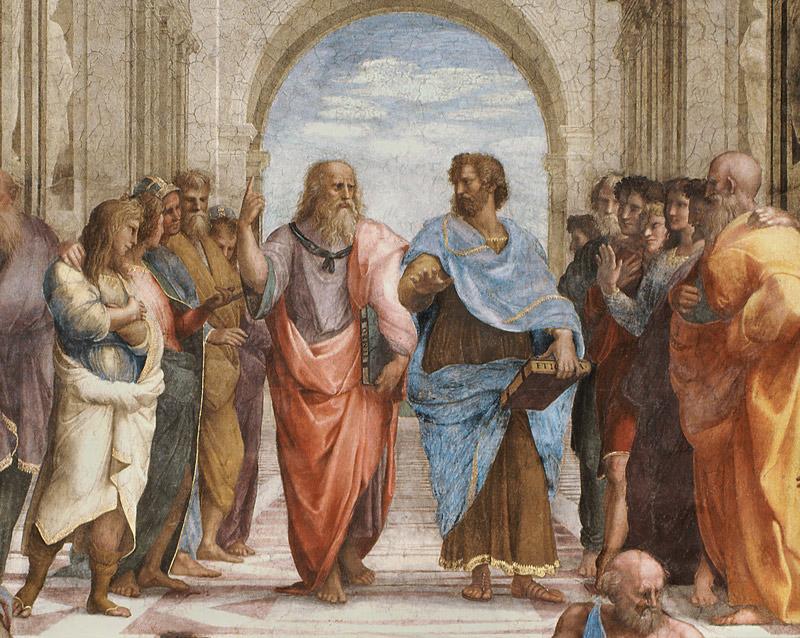
I. Socrates (c. 470–399 BCE): The Philosopher Who Questioned Everything
Early life and historical background
Socrates was born around 470 or 469 BCE in Athens, one of the most politically and culturally influential city-states of the ancient Greek world. His father is traditionally identified as Sophroniscus, a stonemason or sculptor, while his mother, Phaenarete, is described in ancient sources as a midwife.
Details of his early life remain uncertain. Unlike many later philosophers, Socrates did not establish a school in the institutional sense, publish philosophical treatises, or leave behind writings through which his thought could be directly studied. Most of what is known about him comes from the works of Plato, Xenophon, Aristophanes, and, considerably later, Aristotle.
Socrates lived during the rise and subsequent crisis of Athenian democracy. The city experienced extraordinary cultural achievements, including the flourishing of tragedy, architecture, historical writing, and public debate. At the same time, it faced military conflict, factionalism, and political instability, particularly during the Peloponnesian War between Athens and Sparta, fought from 431 to 404 BCE.
These circumstances formed the background to Socrates' persistent examination of authority, virtue, citizenship, and the responsibilities of the individual.
Ancient accounts portray him as a man of modest means who devoted much of his life to conversation in public places. Rather than charging fees for instruction, as some Sophists did, he questioned politicians, poets, craftsmen, and other citizens about the principles underlying their beliefs and conduct.
His physical appearance, as described in ancient sources, differed from conventional ideals of Greek male beauty. He was depicted as stocky, broad-featured, and frequently associated with a plain, unpretentious lifestyle. Yet his intellectual intensity, independence, and commitment to questioning established assumptions made him one of Athens' most distinctive personalities.
Socrates and the art of questioning
Socrates' most enduring contribution was not a single doctrine but a method of philosophical inquiry.
Often called the Socratic method or elenchus, this approach involves asking a series of questions designed to examine a person's beliefs, reveal contradictions, and test whether a proposed definition can withstand careful scrutiny.
For example, Socrates might ask someone to define justice. When the person offered a definition, he would introduce a hypothetical case or ask a further question that exposed a difficulty in the original answer. The discussion would continue until the initial understanding was refined, challenged, or abandoned.
The purpose was not simply to embarrass an opponent. At its best, Socratic questioning sought to distinguish genuine understanding from unexamined confidence.
This method remains influential in contemporary education, law, ethics, and critical thinking. It encourages people to investigate the reasons behind their convictions instead of accepting familiar ideas merely because they are widely held.
Socrates also emphasized his own awareness of intellectual limitations. In Plato's Apology, he investigates the meaning of an oracle's declaration that no one was wiser than he was. His interpretation was not that he possessed universal knowledge, but that he did not mistakenly believe himself knowledgeable about matters he did not understand.
The resulting ideal is often expressed as intellectual humility: recognizing the limits of one's knowledge is an essential step toward wisdom.
The central question: How should one live?
Where many earlier Greek thinkers concentrated on the origin and structure of the cosmos, Socrates placed particular emphasis on human conduct and moral responsibility.
His central concerns included:
-
Virtue: What makes a person genuinely good?
-
Justice: What does it mean to act justly, even when injustice appears advantageous?
-
Knowledge: Can someone truly understand what is good and nevertheless deliberately choose evil?
-
The soul: How should a person care for the moral and intellectual condition of the self?
-
The good life: Is happiness a matter of wealth and reputation, or does it depend on virtue and wisdom?
Socrates is associated with the view that virtue is closely connected to knowledge. In several Platonic dialogues, he argues that people who genuinely understand the good will be motivated to pursue it, while wrongdoing is linked to ignorance or confusion about what is truly beneficial.
This position is often called Socratic intellectualism. Its precise meaning and implications remain subjects of scholarly debate, especially because Plato's dialogues develop different accounts of motivation and moral failure.
Socrates did not regard wealth, social status, or political influence as reliable measures of human excellence. He urged his fellow citizens to give greater attention to the condition of their souls than to the accumulation of external possessions.
His philosophical mission therefore carried a moral and civic dimension. He challenged Athenians to ask whether their ambitions contributed to justice and wisdom or merely reinforced vanity and convention.
Socrates' legacy
Socrates' influence extended far beyond his own lifetime. His students and associates developed divergent philosophical traditions, including those associated with Plato, the Cynics, and other Socratic schools.
His legacy rests especially on three principles:
-
Examine your beliefs. Confidence is not the same as knowledge.
-
Put moral character before external success. A prosperous life is not necessarily a good life.
-
Make reason central to ethical judgment. Important questions deserve examination rather than unquestioned acceptance.
His influence also raises a historical difficulty: because he wrote nothing himself, distinguishing the historical Socrates from the literary Socrates created by Plato and other authors is a continuing scholarly challenge.
Nevertheless, the Socratic ideal remains recognizable wherever people ask difficult questions, challenge contradictions, and regard the pursuit of truth as more important than the comfort of unquestioned opinion.
The trial and death of Socrates
In 399 BCE, Socrates was tried in Athens. The formal charges were impiety—failing to acknowledge the gods recognized by the city and introducing new divine beings—and corrupting the young.
The political background was significant. Athens had recently endured defeat in the Peloponnesian War, the brief oligarchic rule of the Thirty Tyrants, and the restoration of democracy. Some of Socrates' former associates had been connected with controversial political movements, although the precise relationship between these events and the charges against him remains debated.
According to Plato's Apology, Socrates defended himself by explaining that his questioning arose from a philosophical duty rather than a desire to undermine the city. He refused to abandon his activity merely to secure acquittal.
The jury found him guilty and sentenced him to death. In Plato's Crito and Phaedo, Socrates is portrayed as refusing opportunities to escape, maintaining that one must not answer injustice with injustice and that philosophical principles should govern conduct even in the face of death.
He died after drinking a preparation of hemlock, the execution method described in Plato's Phaedo.
The historical details of his final hours are inseparable from the literary and philosophical purposes of the surviving accounts. Nevertheless, his death became one of the most powerful episodes in the history of philosophy: the image of a thinker who remained committed to examining truth and justice despite the ultimate personal cost.
II. Plato (c. 428/427–348/347 BCE): The Architect of Philosophical Idealism
Early life and the world of Athens
Plato was born around 428 or 427 BCE into an influential Athenian family, during the final decades of Athens' political and cultural ascendancy. His original name may have been Aristocles; the name Plato, traditionally associated with the Greek word for breadth, was reportedly a nickname. However, the details of this tradition are uncertain.
Plato grew up amid the Peloponnesian War and its aftermath. His family background connected him to Athens' political elite, and he may initially have considered a political career. His philosophical development, however, was profoundly shaped by his association with Socrates.
The execution of Socrates in 399 BCE became a defining event in Plato's life and thought. The conviction of a philosopher whom Plato regarded as a model of intellectual and moral integrity raised fundamental questions about democracy, political judgment, justice, and the relationship between truth and public opinion.
Plato's later political philosophy cannot be reduced to a simple rejection of democracy. Rather, his writings express a deep concern that political systems can become vulnerable to ignorance, manipulation, factionalism, and the pursuit of immediate popular approval at the expense of wisdom and justice.
Following Socrates' death, ancient traditions associate Plato with travels beyond Athens, potentially including Egypt and parts of southern Italy and Sicily. The details and chronology of these journeys are uncertain, but his engagement with Pythagorean ideas and political figures in Sicily became important elements of later accounts of his life.
Eventually, Plato returned to Athens and established the Academy, traditionally dated to approximately 387 BCE.
The Academy: An institution that transformed intellectual history
Plato founded what is commonly regarded as one of the earliest major institutions of advanced philosophical and mathematical study in the Greek world.
Known as the Academy, it provided an environment in which students and intellectual associates could investigate philosophy, mathematics, astronomy, politics, and related disciplines. It was not a modern university, but it became a landmark in the institutional development of systematic education and philosophical research.
Among those who studied there was Aristotle, who joined the Academy as a young man and remained associated with it for roughly twenty years.
The Academy's influence extended well beyond Plato's lifetime. It became the center of a philosophical tradition that evolved through successive generations, eventually contributing to the development of Platonism and, much later, Neoplatonism.
Plato's importance therefore lies not only in the ideas he formulated but also in the intellectual community he helped establish.
Plato's philosophical method: Dialogue and dialectic
Unlike Socrates, Plato left an extensive body of philosophical writing, much of it composed in the form of dialogues.
In these works, characters discuss questions such as the nature of justice, love, knowledge, beauty, courage, political authority, and the immortality of the soul. Socrates appears as the central interlocutor in many of them, although scholars distinguish between the historical Socrates and the philosophical character developed across Plato's writings.
Plato rarely presents philosophy as a simple collection of conclusions. Instead, he stages arguments, tests definitions, introduces objections, and explores the consequences of competing positions.
This method, known as dialectic, seeks to move beyond appearances and assumptions toward a more coherent understanding of fundamental principles.
Among Plato's most influential dialogues are:
-
Apology — Socrates' defense at his trial and an exploration of philosophical responsibility.
-
Crito — justice, civic obligation, and the question of whether Socrates should escape prison.
-
Phaedo — the soul, death, and philosophical preparation for dying.
-
Symposium — love, beauty, and the ascent from physical attraction toward the contemplation of beauty itself.
-
Meno — virtue, knowledge, and the possibility of learning.
-
Phaedrus — rhetoric, love, the soul, and the nature of philosophical communication.
-
The Republic — justice, education, political authority, and the ideal organization of society.
-
Theaetetus — the nature of knowledge.
-
Parmenides — a critical examination of difficulties in the theory of Forms.
-
Timaeus — cosmology, the structure of the universe, and the relationship between order and creation.
-
Laws — legislation, institutions, and the practical organization of political life.
These works address different problems and sometimes explore tensions that Plato does not definitively resolve. Consequently, his philosophy is best understood as a developing body of inquiry rather than a completely static system.
The Theory of Forms: Reality beyond appearances
One of Plato's most influential philosophical contributions is the theory commonly known as the Theory of Forms or Theory of Ideas.
Plato asks whether the things we encounter through our senses provide the most fundamental kind of reality. Objects change, deteriorate, and differ from one another. Yet human beings can reason about concepts such as justice, equality, beauty, and goodness as if they possess a meaning that exceeds any single example.
Consider a beautiful building, a beautiful painting, and a beautiful human face. They are different objects, yet we can discuss beauty as a concept that applies to all of them.
Plato's theory proposes that intelligible Forms provide a deeper basis for understanding such concepts. The Form of Beauty, for example, is not simply another beautiful object. It represents beauty itself, considered independently of the particular things that appear beautiful to us.
The relationship between Forms and physical objects is complex, and Plato develops it differently across his dialogues. Nevertheless, the general distinction between intelligible reality and the changing world of sensory experience became central to the Platonic tradition.
This theory should not be understood as merely claiming that physical objects are imaginary. Rather, Plato questions whether sensory experience alone can provide the stable, universal knowledge that philosophical understanding requires.
The Allegory of the Cave
One of the most famous passages in the history of philosophy appears in Book VII of The Republic.
Plato asks readers to imagine prisoners who have spent their entire lives chained inside a cave. They face a wall on which shadows are cast by objects moving behind them. Because they have never seen anything else, the prisoners assume that these shadows constitute reality.
If one prisoner were freed, turned toward the objects, and eventually led outside into the sunlight, the experience would initially be painful and disorienting. Gradually, however, the former prisoner would discover a world far more extensive than the shadows previously taken for reality.
The allegory illustrates Plato's account of education and philosophical enlightenment. Human beings may mistake familiar appearances, social conventions, and popular beliefs for the whole of truth. Genuine learning requires turning the mind toward deeper explanations, even when doing so challenges established assumptions.
The sunlight is associated with the highest principle of intelligibility in the allegory: the Form of the Good. Plato presents the Good as essential to understanding and knowledge, much as the sun makes vision possible in the visible world.
The allegory also introduces a difficult political question. If philosophers gain a deeper understanding of justice and goodness, what obligations do they have toward those who remain within the cave?
For Plato, philosophical education is not merely a private intellectual achievement. It carries responsibilities toward society.
Justice, the soul, and the ideal state
In The Republic, Plato examines justice at both the individual and political levels.
He proposes an analogy between the structure of the human soul and the organization of an ideal city. The soul is described as having three aspects:
-
Reason, which seeks truth and should guide the whole person.
-
Spirit, associated with courage, indignation, and the desire for honor.
-
Appetite, associated with bodily needs, pleasures, and material desires.
A just individual, in this account, is one whose different motivations operate in an appropriate order, with reason exercising guidance rather than being dominated by uncontrolled appetites or the pursuit of honor.
Plato's ideal city is organized around three corresponding groups: rulers, auxiliaries or guardians responsible for defense, and producers engaged in economic activity. The rulers are expected to possess philosophical understanding and to govern for the common good.
This model leads to his famous argument that societies will not escape their deepest political problems until philosophers become rulers or those who rule become genuine philosophers.
However, Plato's political thought also contains controversial and authoritarian elements. His ideal state restricts important aspects of individual freedom, assigns social roles according to a hierarchical conception of ability, and subjects education and cultural expression to political oversight. His treatment of women among the guardian class is unusual in its historical context, yet the broader political system remains far removed from modern democratic ideals.
Plato's work is therefore both foundational and contested: it offers an enduring analysis of political competence and justice while raising difficult questions about freedom, equality, and the concentration of authority.
Plato's later life and death
Plato spent much of his later life teaching and writing at the Academy. He also became involved, directly or indirectly, in attempts to influence political affairs in Syracuse, a powerful Greek city in Sicily.
These episodes are traditionally associated with his hopes that philosophical principles might shape actual government. The attempts were unsuccessful and exposed the difficulties of translating an ideal political theory into practice.
Plato died around 348 or 347 BCE, probably in Athens. The Academy continued after his death and remained influential for centuries, although its doctrines and methods evolved considerably.
Plato's legacy
Plato's influence has been immense. His writings shaped ancient Greek philosophy, Roman intellectual life, Christian theology, Islamic philosophy, Renaissance humanism, and modern metaphysics and political theory.
His ideas influenced thinkers who accepted his theory of Forms, thinkers who modified it, and critics who rejected it.
Plato's legacy includes several lasting questions:
-
Is reality deeper than what the senses reveal?
-
Can universal truths exist independently of individual opinions?
-
What distinguishes knowledge from belief?
-
What makes a political system just?
-
Should political power be guided by expertise, moral judgment, or popular consent?
-
What is the relationship between education and human freedom?
Plato transformed the questioning spirit associated with Socrates into a far-reaching investigation of reality, knowledge, morality, and political order.
III. Aristotle (384–322 BCE): The Systematic Philosopher of the Natural and Human Worlds
Early life in Stagira
Aristotle was born in 384 BCE in Stagira, a Greek city in the region of Chalcidice in northern Greece. His father, Nicomachus, was traditionally described as a physician connected with the Macedonian royal court. This family background may help explain Aristotle's later interest in biology, anatomy, and the systematic study of living organisms, although the precise influence of his childhood education is uncertain.
Aristotle grew up outside Athens, in a political world increasingly shaped by the power of Macedon. At approximately seventeen or eighteen years of age, he traveled to Athens and joined Plato's Academy.
He remained associated with the Academy for about twenty years, first as a student and later as a teacher or researcher. During this period, he studied and developed ideas in philosophy, logic, natural science, metaphysics, and other fields.
Although Plato profoundly influenced him, Aristotle eventually developed a distinctive approach that differed from some of his teacher's most important doctrines.
Aristotle's departure from Plato's philosophy
The relationship between Plato and Aristotle is often presented as a conflict between idealism and empiricism. This contrast captures an important difference, but it can also be misleading if taken too far.
Plato emphasized the role of intelligible Forms in explaining the nature of reality and the possibility of knowledge. Aristotle argued that the Forms, understood as separately existing entities, were not necessary to explain the properties and organization of the things we encounter.
For Aristotle, understanding generally begins with experience. Human beings observe particular objects and events, compare them, identify patterns, and develop general explanations through reasoning.
This does not mean Aristotle rejected abstract thought. On the contrary, he considered philosophical reasoning indispensable. His disagreement concerned how universal concepts relate to particular things and what kind of explanation provides the best account of reality.
In his writings, Aristotle repeatedly examines earlier philosophical theories, including Plato's, identifying their strengths and weaknesses before developing his own arguments.
His intellectual independence was not a rejection of his teacher's achievements but an attempt to answer philosophical questions through a different explanatory framework.
Travels, research, and the founding of the Lyceum
After Plato's death around 348/347 BCE, Aristotle left Athens. Ancient accounts associate him with Assos and Mytilene, where he continued his philosophical and scientific work.
In 343 or 342 BCE, he was invited to the Macedonian court to educate Alexander, the son of King Philip II. Alexander would later become known as Alexander the Great, the conqueror whose campaigns transformed the political and cultural geography of the eastern Mediterranean and much of western and central Asia.
Aristotle's precise influence on Alexander's later political decisions and imperial policies remains uncertain. Although their association is historically significant, it would be an exaggeration to attribute Alexander's conquests or governing methods directly to Aristotle's teaching.
Aristotle eventually returned to Athens, where he established his own school, the Lyceum, around 335 BCE.

The Lyceum became a center for philosophical investigation, teaching, and the systematic collection of information. Aristotle and his associates studied a remarkably broad range of subjects, from logic and metaphysics to animal anatomy, political constitutions, rhetoric, poetry, and ethics.
The school is associated with the Peripatetic tradition, a name traditionally connected with walking while discussing philosophy, although the historical details of the term's origin are not entirely certain.
Aristotle's approach combined theoretical analysis with the collection and classification of evidence. His works on animals, for example, demonstrate an extensive interest in comparing species, identifying structures, and explaining biological functions.
Logic: The structure of valid reasoning
One of Aristotle's most influential contributions was his systematic study of logic.
His works on logic were later collected under the title Organon, meaning an instrument or tool. They examine concepts, propositions, arguments, demonstration, and the conditions under which conclusions follow from premises.
Aristotle's best-known logical contribution is his analysis of the syllogism.
A traditional example is:
-
All human beings are mortal.
-
Socrates is a human being.
-
Therefore, Socrates is mortal.
The argument illustrates how a conclusion can follow necessarily from two premises when the reasoning is valid.
Aristotle's logical system was not identical to modern symbolic logic, which has developed far beyond ancient syllogistic theory. Nevertheless, his work established foundational questions about the structure of arguments, the relationship between premises and conclusions, and the distinction between valid reasoning and persuasive but defective argument.
For centuries, Aristotelian logic served as a central framework for philosophical and scholarly education in Europe and the Middle East.
Metaphysics: What does it mean to exist?
Aristotle's Metaphysics investigates fundamental questions concerning being, causation, substance, form, and the principles that make reality intelligible.
He asks what it means for something to exist and how different kinds of things can be understood as entities with identifiable properties and structures.
One important distinction in his philosophy is between matter and form. Matter is that out of which something is constituted; form is the organization or actuality through which it becomes the particular thing it is.
Consider a bronze statue. The bronze provides its material, while its form accounts for its organization as a statue of a particular shape. In living things, the relationship between matter and form is more complex because Aristotle treats organisms as unified living substances rather than merely assembled objects.
This approach differs from Plato's account of separately existing Forms. Aristotle generally locates form within the individual substance rather than treating it as an independently existing entity of the Platonic kind.
Another central concept is the distinction between potentiality and actuality. An acorn has the potential to become an oak tree under appropriate conditions; a mature oak is an actualized development of that potential.
This framework allows Aristotle to analyze change without assuming that change is simply the replacement of one unrelated state by another. It became an important element of later metaphysics and medieval philosophical theology.
The four causes
Aristotle argues that a comprehensive explanation often requires attention to four kinds of cause or explanatory principle.

Material cause
What something is made of. In the case of a bronze statue, the material cause is bronze.
Formal cause
The structure or form that makes something the kind of thing it is, such as the statue's particular shape.
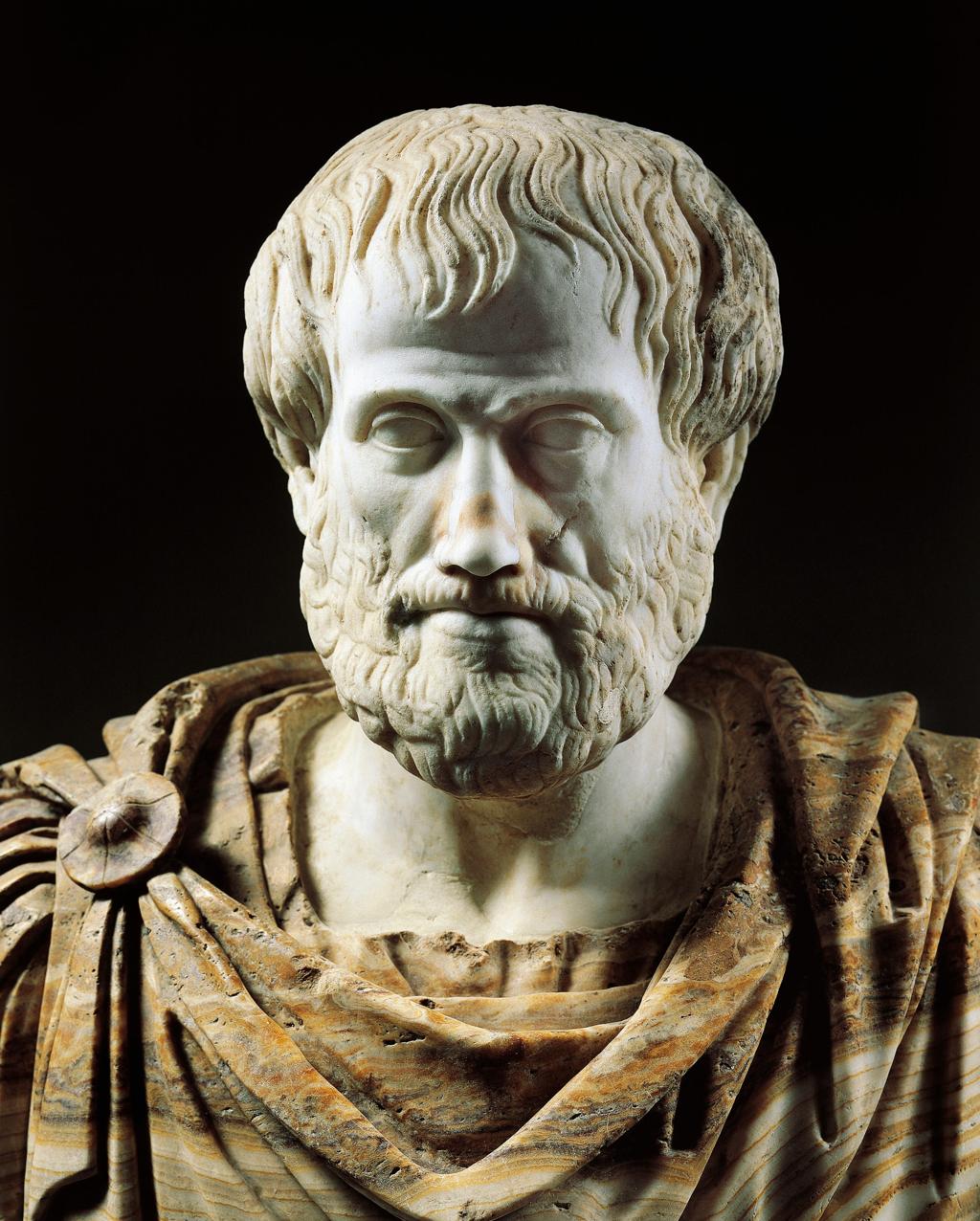
Efficient cause
The source of change or production, such as the sculptor who makes the statue.
Final cause
The end, purpose, or function in terms of which something is explained, such as the intended purpose of the statue.
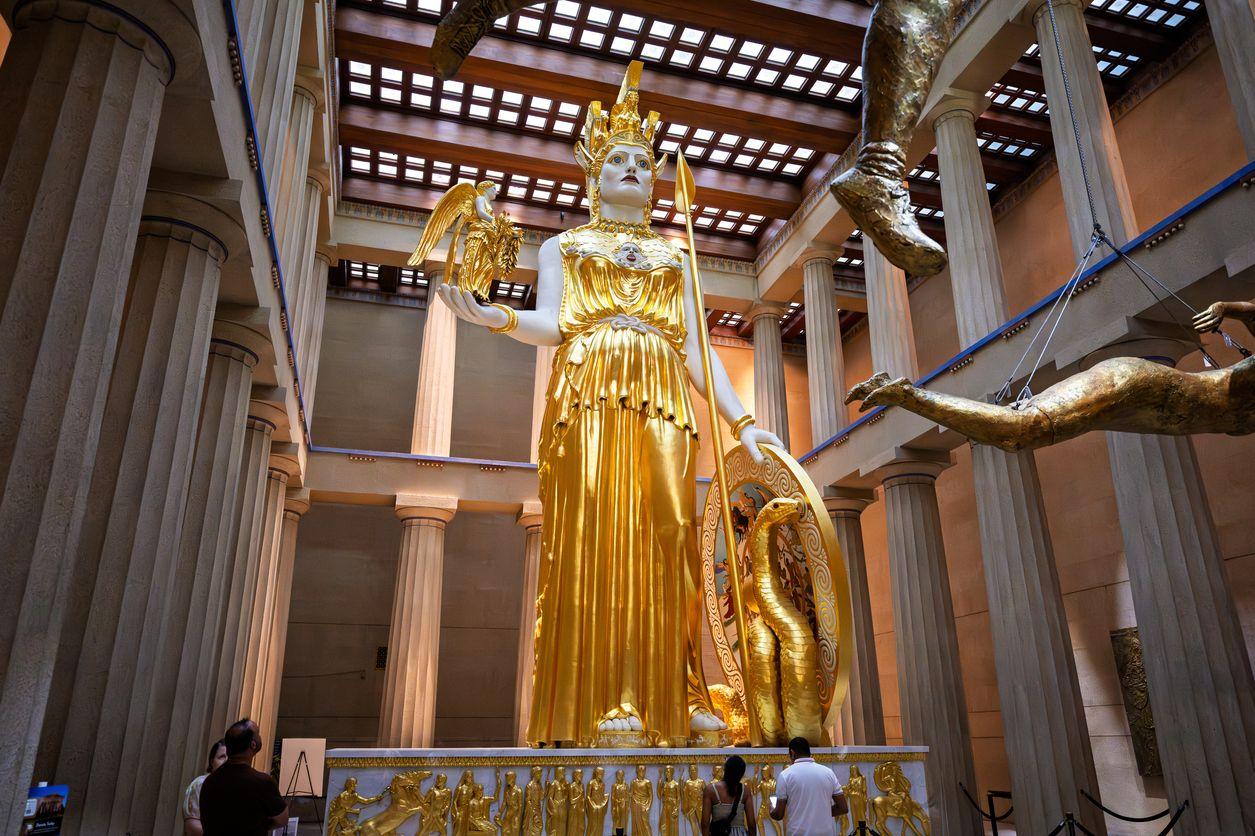
These causes should not simply be equated with the modern scientific concept of a physical cause. Aristotle's framework is broader: it seeks to explain what something consists of, what makes it the thing it is, how it comes to be, and what role or end its activity serves.
The four causes became highly influential in later philosophy, although modern sciences often explain natural phenomena through frameworks different from Aristotle's teleological account.
Biology and the study of nature
Aristotle was one of antiquity's most important investigators of living organisms. His biological writings examine animal anatomy, reproduction, development, behavior, and differences between species.
Works such as History of Animals, Parts of Animals, and Generation of Animals demonstrate his interest in systematic observation and comparative explanation.
He drew on reports from others as well as his own observations, including accounts of marine life. Some of his descriptions were remarkably perceptive, while others contained errors that later scientific investigation corrected.
His biology was not modern experimental science, and many of his explanations were constrained by the knowledge and methods available in the fourth century BCE. Nevertheless, his attempt to classify organisms, investigate their structures, and explain their functions represented an important stage in the history of natural inquiry.
Aristotle's influence on biology and natural philosophy remained substantial for centuries. Later researchers sometimes relied too heavily on his authority, but his works also helped establish the principle that nature could be investigated through sustained observation and reasoned comparison.
Ethics: The search for human flourishing
Aristotle's ethical philosophy is most fully developed in the Nicomachean Ethics, one of the most influential works in the history of moral thought.
Its central question is straightforward but profound: What is the highest good toward which human life should be directed?
Aristotle identifies this good with eudaimonia, a Greek term commonly translated as happiness, flourishing, or living well. It does not refer merely to a pleasant feeling or temporary satisfaction. Rather, it describes a life in which human capacities are developed and exercised well over time.
Aristotle argues that human beings possess distinctive capacities for reason and that a good human life involves the excellent exercise of those capacities, expressed through virtuous activity.
His account emphasizes several important virtues, including courage, temperance, generosity, justice, and practical wisdom.
He also develops the doctrine commonly called the Golden Mean. According to this account, many moral virtues involve finding an appropriate response between excess and deficiency.
Courage, for example, stands between rashness and cowardice. Generosity occupies a position between wastefulness and miserliness.
The mean is not a mathematical midpoint or a universal compromise. The appropriate response depends on the circumstances, the person, and the demands of the situation. Determining it requires phronesis, or practical wisdom: the ability to deliberate well about what should be done.
Aristotle also stresses the importance of habituation. People become just by performing just actions, courageous by practicing courage, and temperate through the development of appropriate habits. Moral character is shaped through education, repeated conduct, social relationships, and the exercise of judgment.
His ethics therefore combines reflection on the human good with a practical account of how people develop the character necessary to live well.
Politics: The human being as a political animal
In Politics, Aristotle examines the origins, purposes, and structures of political communities.
His famous description of the human being as a political animal expresses the idea that human flourishing depends fundamentally on life within a community. Human beings possess speech and reason, enabling them to discuss justice, advantage, goodness, and the common life.
For Aristotle, the political community is not simply a mechanism for preventing violence or protecting private interests. Properly organized, it creates conditions in which citizens can develop their capacities and pursue a good life.
He examines different forms of government, including monarchy, aristocracy, and constitutional government, alongside their corrupt counterparts: tyranny, oligarchy, and democracy as he uses the term in his particular classification.
His terminology does not correspond exactly to modern political categories. In particular, Aristotle's critical use of democracy often concerns government by a faction pursuing its own interest rather than the modern idea of representative democratic government grounded in equal citizenship.
Aristotle compares political systems, considers the role of laws and institutions, and emphasizes the importance of political stability and a substantial middle class.
Yet his political thought also reflects the profound limitations of ancient Greek society. He defended forms of natural hierarchy, including the subordination of women and the institution of slavery, positions that conflict sharply with modern principles of human equality and universal freedom.
His political philosophy must therefore be approached both as a foundational investigation of institutions and citizenship and as a historical work shaped by the exclusions of its time.
Rhetoric, poetry, and human communication
Aristotle's interests extended beyond metaphysics, science, and political theory.
In Rhetoric, he analyzes persuasion and identifies three influential means of appeal: ethos, the credibility or character of the speaker; pathos, the emotions of the audience; and logos, the reasoning and argument presented.
These categories remain widely used in the study of communication, public speaking, law, and political discourse.
In Poetics, Aristotle investigates tragedy, plot, character, and the representation of human action. He argues that plot is central to tragedy and examines how a well-constructed dramatic action can evoke pity and fear.
His discussion of catharsis has generated extensive scholarly debate, particularly concerning whether it refers to purification, clarification, emotional release, or some combination of these ideas.
Aristotle's literary theory helped establish a systematic approach to the analysis of dramatic structure and artistic representation. It also demonstrated his conviction that human creations, like natural phenomena and political institutions, could be examined through careful conceptual analysis.
Aristotle's final years and death
Aristotle's position in Athens became more precarious following the death of Alexander the Great in 323 BCE. Anti-Macedonian sentiment intensified, and Aristotle faced a charge of impiety.
Ancient accounts state that he left Athens for Chalcis on the island of Euboea, explaining his departure with a remark that he would not allow the Athenians to sin against philosophy a second time—a reference traditionally understood as an allusion to Socrates' execution. The exact wording and historical circumstances should be treated cautiously.
Aristotle died in Chalcis in 322 BCE, at approximately sixty-two years of age.
His school continued under the leadership of his successor, Theophrastus, and the Peripatetic tradition preserved and developed many aspects of his philosophy.
Aristotle's legacy
Aristotle's influence was exceptional in its breadth. His writings shaped late antique philosophy, Byzantine scholarship, medieval Islamic thought, Jewish philosophy, Christian scholasticism, and the intellectual traditions of Renaissance and early modern Europe.
In the medieval Islamic world, philosophers such as Al-Farabi and Ibn Sina engaged with Aristotelian concepts, while Ibn Rushd produced influential commentaries on Aristotle's works.
In medieval Europe, Aristotle became central to scholastic philosophy, particularly through the work of Thomas Aquinas, who sought to integrate Aristotelian philosophy with Christian theology.
Aristotle's scientific conclusions were not universally correct, and several were eventually overturned by developments in modern physics, astronomy, and biology. His lasting importance lies not in the claim that every conclusion was true but in the extraordinary scope of his inquiries and his systematic attempt to explain the world through coherent argument.
His legacy encompasses logic, metaphysics, ethics, political theory, biology, literary criticism, and the philosophy of science. Few philosophers have contributed to so many distinct fields.
IV. Socrates, Plato, and Aristotle: A Comparative Analysis
The intellectual relationship among Socrates, Plato, and Aristotle represents one of the most consequential sequences in the history of philosophy. Their ideas are connected, but each approached fundamental questions from a distinctive perspective.
Socrates emphasized moral examination and the pursuit of wisdom. Plato developed philosophical dialogues that explored the relationship between knowledge, reality, justice, and the ideal order of society. Aristotle created an expansive system of inquiry that sought to explain the natural world, human behavior, logical reasoning, and political institutions.
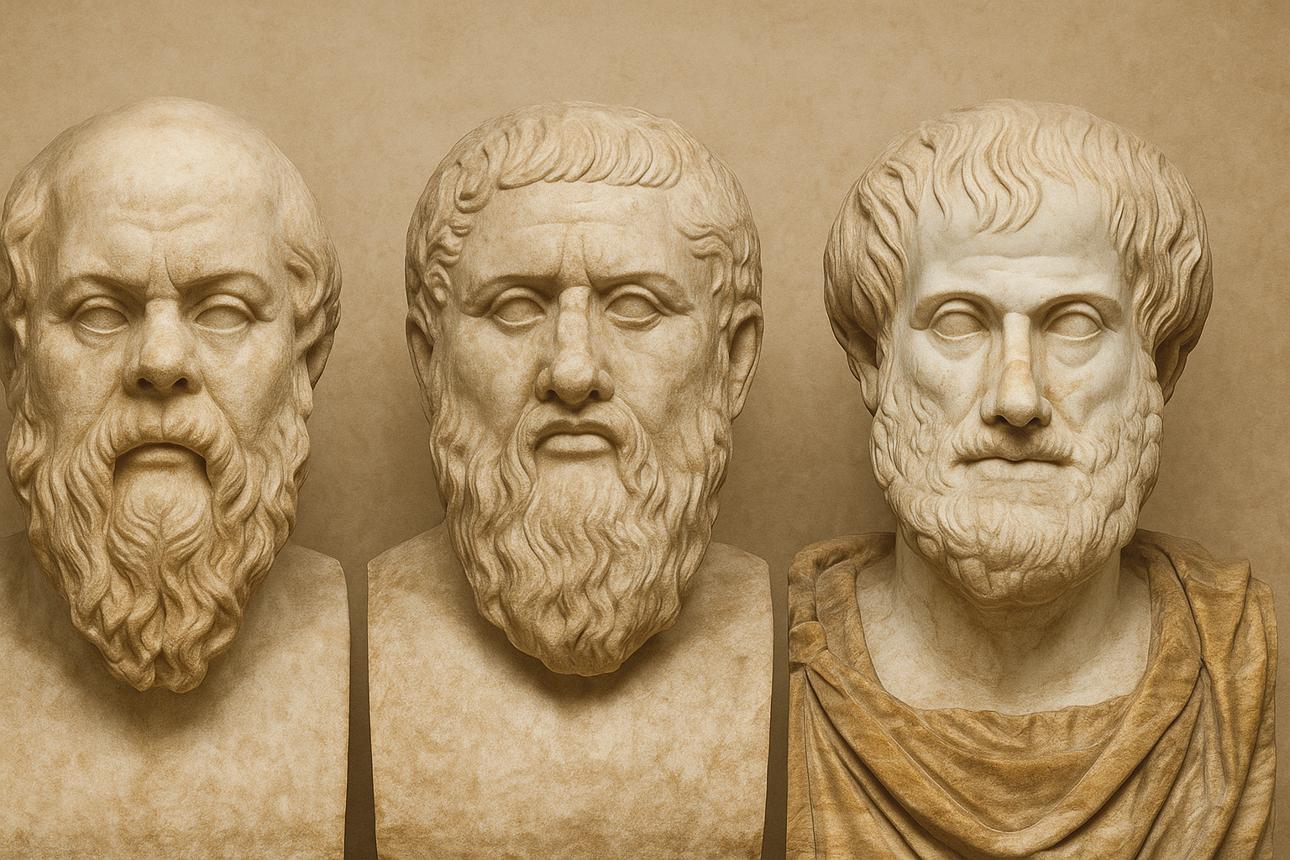
Their differences can be summarized as follows:
| Philosophical question | Socrates | Plato | Aristotle |
| Primary concern | Virtue, wisdom, and the examined life | Forms, knowledge, justice, and ideal political order | Explanation, observation, logic, ethics, and nature |
| Method | Questioning and refutation | Dialogue and dialectic | Logical analysis, observation, classification, and demonstration |
| Knowledge | Recognizing ignorance and examining beliefs | Understanding intelligible realities beyond appearances | Developing knowledge through experience, reasoning, and the study of causes |
| Ethics | Virtue and moral knowledge | The Good, justice, and harmony of the soul | Virtue, practical wisdom, and human flourishing |
| Politics | Critical examination of civic values and authority | Philosophical rule and the ideal state | Comparative analysis of constitutions and political communities |
| Historical legacy | Model of philosophical integrity | Major tradition of philosophical idealism | Systematic framework spanning numerous disciplines |
These distinctions are useful, but they should not obscure the overlap among their concerns. Plato's dialogues retain the questioning method associated with Socrates, while Aristotle's ethics and politics continue the investigation of the good life that occupied both his predecessors.
Three generations of philosophical development
Socrates — The Questioner
c. 470–399 BCE
He challenged assumptions, examined moral concepts, and insisted that a worthwhile life requires critical reflection and attention to virtue.
Plato — The System Builder
c. 428/427–348/347 BCE
He developed comprehensive accounts of reality, knowledge, justice, and political order, while establishing the Academy as a lasting center of philosophical study.
Aristotle — The Systematic Investigator
384–322 BCE
He developed detailed theories of logic, nature, causation, ethics, politics, and artistic representation, combining abstract reasoning with the investigation of particular things.
Their chronological relationship is equally important. Socrates was Plato's teacher, and Plato was Aristotle's teacher. Yet intellectual inheritance did not mean unquestioning agreement. Aristotle's departure from aspects of Plato's philosophy demonstrates that a tradition can preserve its foundations while subjecting its conclusions to criticism.
This relationship also offers a broader lesson about intellectual history: the most influential traditions often develop through a combination of continuity, disagreement, and the creation of new methods.
V. Their Influence on World Civilization
The importance of these three philosophers cannot be confined to ancient Athens. Their works entered intellectual traditions across geographical, linguistic, and religious boundaries.
The ancient Greek and Hellenistic worlds
Socrates became the central figure in several philosophical movements, while Plato's Academy and Aristotle's Lyceum established institutional models for philosophical education and research.
After Alexander the Great's conquests, Greek language and intellectual traditions spread across a vast area of the eastern Mediterranean and western Asia. Philosophical ideas circulated alongside mathematics, medicine, astronomy, and other fields of learning.
Later schools, including Stoicism and Epicureanism, developed their own approaches to ethics and the good life while engaging with questions that Socrates, Plato, and Aristotle had helped establish.
The Roman world
Roman intellectuals adopted and adapted Greek philosophy. Plato's writings influenced later Platonist traditions, while Aristotelian logic and natural philosophy contributed to scholarly education.
Socratic questioning also became an important model for moral reflection and philosophical dialogue. Roman thinkers did not simply reproduce Greek ideas; they interpreted them in relation to Roman political life, law, rhetoric, and ethics.
The Persianate and Islamic intellectual worlds
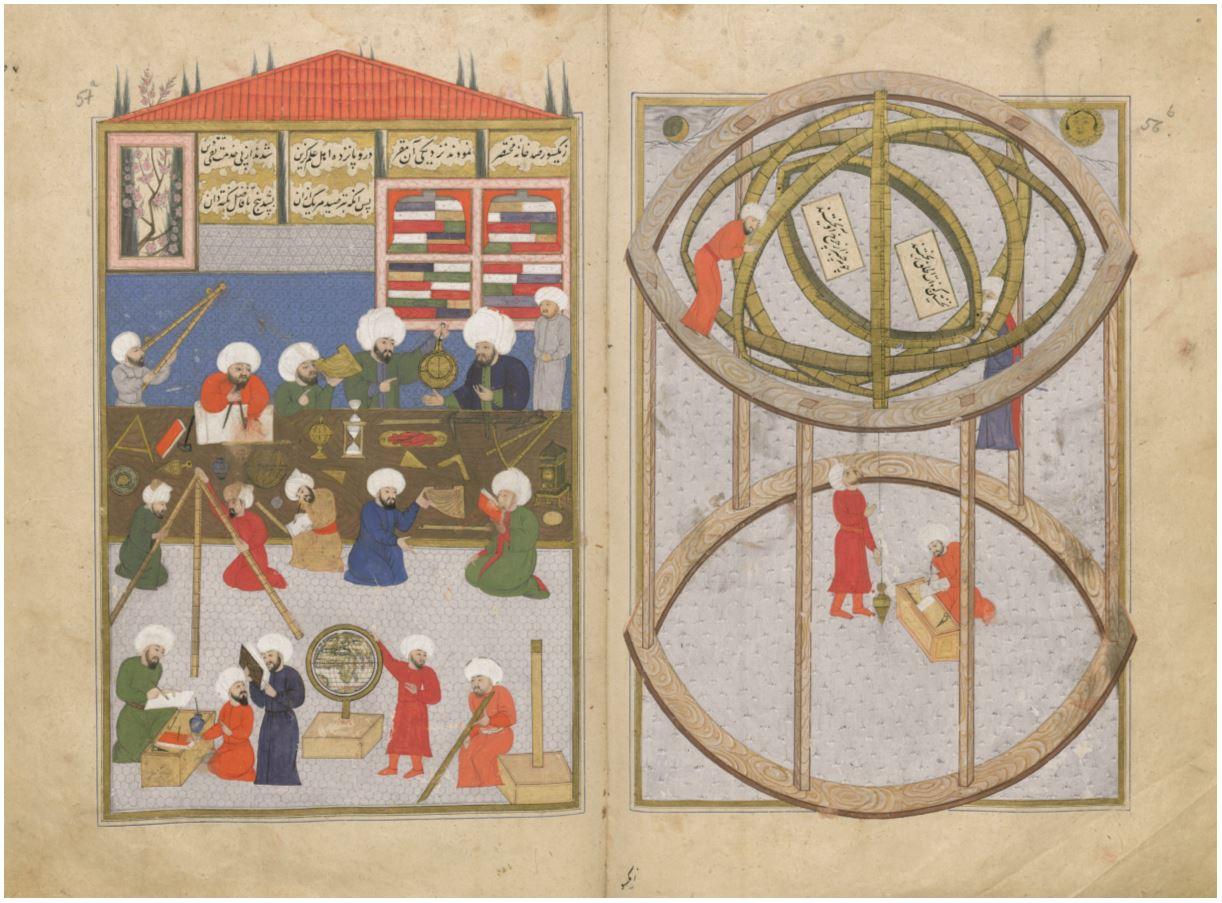
The transmission of Greek philosophy into the Islamic intellectual world was a major episode in the history of global knowledge.
During the Abbasid period and beyond, scholars translated and studied Greek philosophical works, often through Syriac intermediaries and within broader traditions of commentary and debate. Aristotle's logic and metaphysics became especially influential, while Platonic ideas were transmitted through several channels, including later Platonist writings.
Philosophers writing in Arabic and Persian did not merely preserve ancient Greek thought. They challenged it, reinterpreted it, and integrated selected elements into original philosophical systems.
Al-Farabi explored logic, political philosophy, and the relationship between philosophy and religion. Ibn Sina developed a distinctive metaphysical system that drew substantially on Aristotle while advancing arguments of his own. Ibn Rushd became renowned for his detailed commentaries on Aristotle.
In Persian intellectual history, Aristotelian and Platonic ideas became part of a wider conversation involving metaphysics, logic, ethics, theology, and political thought. Their influence should therefore be understood as part of an interconnected history of scholarship rather than as the exclusive possession of any single civilization.
Medieval Europe and Renaissance humanism
Aristotle became a central authority in medieval European universities, particularly in logic, natural philosophy, and metaphysics. His works, often encountered through Arabic commentaries and translations, contributed to the development of scholastic philosophy.
Plato's influence also remained significant, especially through traditions associated with Augustine, later Platonism, and Renaissance scholarship.
During the Renaissance, renewed interest in ancient Greek texts encouraged scholars to reconsider the intellectual achievements of classical antiquity. The resulting revival was not a simple return to the past but a reexamination of ancient philosophy in the light of new cultural, religious, and scientific questions.
Modern philosophy, science, and education
Modern philosophy has repeatedly revisited the questions raised by these thinkers.
Socratic questioning remains a model for critical thinking and philosophical education. Plato's theory of Forms continues to inform debates about universals, abstract objects, mathematics, justice, and the nature of reality. Aristotle's writings remain important in contemporary discussions of virtue ethics, biological classification, political theory, logic, and the philosophy of science.
Their ideas have also been criticized and revised. Modern science has rejected numerous ancient cosmological and biological explanations, while contemporary political philosophy challenges hierarchical assumptions embedded in some of their writings.
Yet the questions themselves remain alive. What constitutes a good life? What is the relationship between evidence and reason? How should societies balance expertise and democratic participation? Can moral principles be objective? What makes an explanation adequate?
The continued relevance of these questions explains why the three philosophers remain subjects of study across the humanities and social sciences.
VI. The Enduring Relevance of Their Philosophies
The achievements of Socrates, Plato, and Aristotle extend beyond the historical importance of their writings. Each offers a different way to approach the problems of human existence.
Socrates teaches the importance of intellectual honesty. People cannot reliably improve their understanding if they refuse to examine their assumptions or acknowledge their mistakes. His example suggests that a willingness to question oneself is a condition of meaningful intellectual and moral development.
Plato emphasizes the search for principles beyond immediate appearances. Public opinion, personal preference, and sensory experience do not automatically provide adequate answers to questions of justice, truth, or goodness. His philosophy challenges us to seek coherent explanations and examine the foundations of our beliefs.
Aristotle demonstrates the importance of systematic investigation. Understanding the world requires more than speculation. It involves observing particular things, distinguishing relevant features, examining alternative explanations, and reasoning carefully about causes and consequences. His ethics also reminds us that good judgment is developed through practice, education, and experience.
Taken together, these approaches offer a powerful intellectual framework: question assumptions, seek deeper explanations, and test ideas through disciplined reasoning.
Their philosophies are not interchangeable, and none provides a complete solution to every modern problem. Nevertheless, their different methods can complement one another. Socratic questioning can expose weaknesses in an argument; Platonic inquiry can investigate the principles underlying it; and Aristotelian analysis can clarify the evidence, distinctions, and causal relationships involved.
This combination helps explain why their works continue to reward careful reading.
Final Thought: Three Lives, One Enduring Intellectual Revolution
Socrates, Plato, and Aristotle transformed the possibilities of philosophical inquiry. They did not agree on every fundamental question, nor did they offer a single unified doctrine. Their significance lies precisely in the diversity of their approaches and the continuing dialogue among them.
Socrates made the examination of human beliefs and moral conduct a defining philosophical activity. Plato expanded that inquiry into a profound investigation of reality, knowledge, justice, and political life. Aristotle developed a remarkably comprehensive approach to understanding the natural and human worlds through logic, observation, classification, and systematic explanation.
Their intellectual achievements became foundational to traditions that extended far beyond ancient Greece, influencing philosophical and scientific discussions across Europe, the Middle East, and the wider world.
More than two millennia after their deaths, their central questions remain unresolved in many respects. What does it mean to know something? How should we distinguish truth from appearance? What makes a person virtuous? What is justice, and how should political authority be exercised? How can human beings develop their capacities and live well together?
The enduring power of these philosophers lies not in providing final answers to every question but in demonstrating how profoundly the act of questioning can transform human understanding.
Their legacy is therefore more than a chapter in the history of philosophy. It is an invitation to think critically, investigate carefully, and recognize that the pursuit of wisdom is an ongoing human endeavor.

Page Term Reference
Comments